Admin Portal · Freelance
BurmaUni
The internal admin & operations portal for an EdTech platform — ~30 modules (catalog, payments, instructors, students, promotions) behind a custom JWT-based RBAC system that enforces access at the route, component, and action levels.
- TypeScript
- React
- Vite
- React Router
- TanStack Query
- TanStack Table
- Zustand
- nuqs
- Zod
- Axios
- Tailwind CSS
Overview
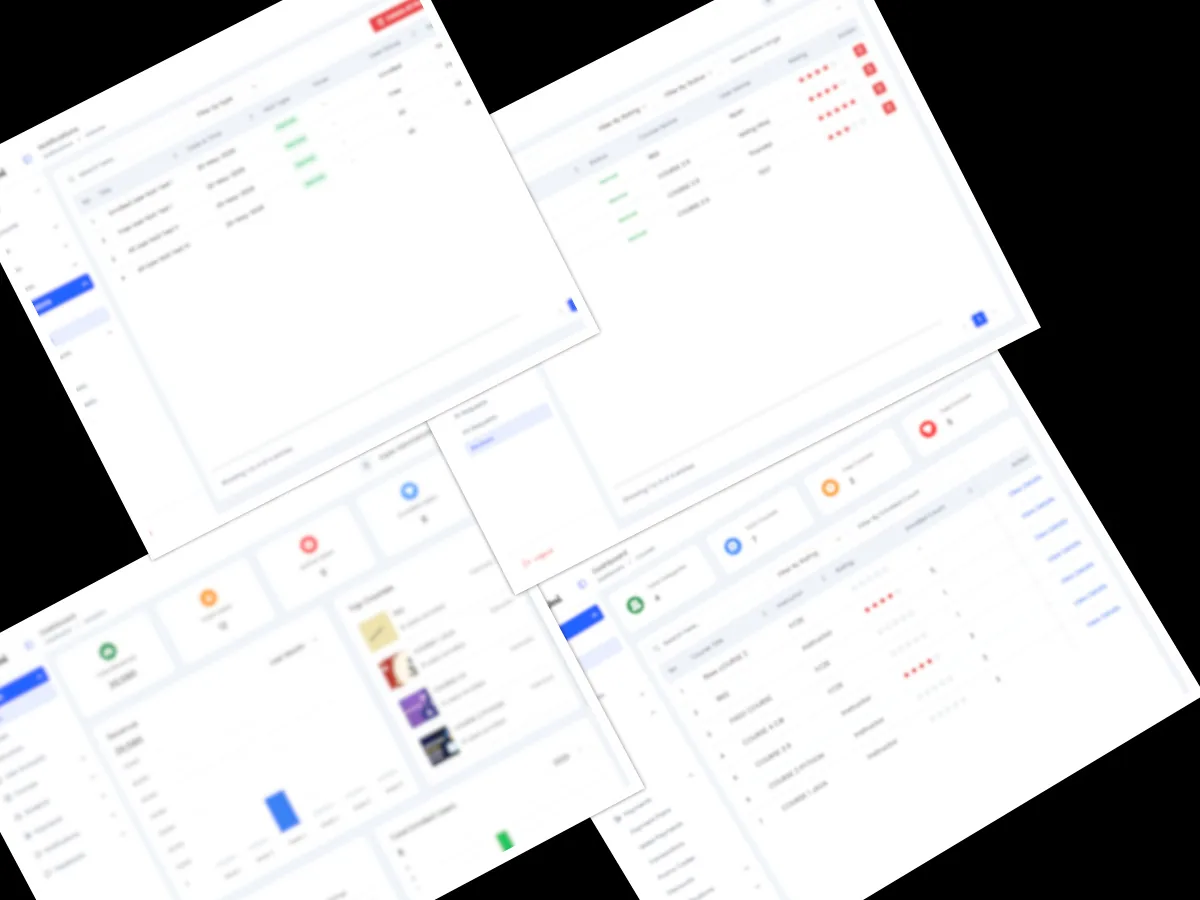
BurmaUni’s web portal is the internal admin and operations control plane for an online education platform — the back office staff use to run the whole business: course catalog, lessons and curriculum, instructors, students, payments, promotions, notifications, and feedback. It isn’t a CRUD demo; it’s a role-driven SaaS back office with around 30 feature modules and 25 API service domains, where what a given staff member can see and do is governed by a fine-grained permission system.
Architecture
The codebase is feature-sliced — organized by domain rather than by file type — with Vite path aliases (@apis, @components, @pages, @configs, @hooks) keeping imports clean.
The separation worth calling out is in the data layer: apis/services/ holds the raw HTTP functions, and apis/queries/ wraps each one in a TanStack Query hook. Pages never touch Axios directly — they consume typed hooks like useGetAllCourses() / useCreateCourse(). Cache invalidation is precise rather than guesswork: per-domain query-key factories (coursesKeys.all / .detail(id) / .filters(obj)) replace scattered magic strings, so a mutation invalidates exactly the keys it should.
Role-based access control
The standout subsystem is a self-contained RBAC module that enforces access at three levels:
- Route —
useRequirePermission(PERMISSIONS.accounts.read)/ a<ProtectedRoute>guard. - Component —
<PermissionGate>and<Can resource="accounts" action="create">to gate individual UI elements. - Imperative —
usePermissions().can('accounts', 'delete')for logic that isn’t just rendering.
Permissions are encoded as resource:action strings (courses:publish, purchases:refund, assignments:grade), parsed out of the JWT payload at login and stored in a Set<Permission> for O(1) lookups. There are 6 roles (SuperAdmin, Admin, Instructor, Analyst, CustomerSupport, MarketingStrategist) across ~35 resources, each with create/read/update/delete plus domain-specific verbs. A findFirstAccessibleRoute() helper even derives each user’s landing page from their permission set, so different roles open into different home screens.
Silent JWT refresh
Auth uses short-lived JWTs with silent refresh, and the Axios interceptor handles the classic concurrency hazard correctly. When a 401 arrives and several requests are in flight, only the first triggers POST /auth/refresh-token; the rest are parked in a failedQueue and replayed with the new token once refresh resolves — so there’s no thundering herd of refresh calls. The refresh request itself uses a bare Axios instance to avoid an interceptor loop, and on failure the interceptor clears cookies/storage and redirects to login.
URL-driven, server-side tables
Every list page (~20 of them) is built on one generic hook, use-data-table-params, that makes the URL the source of truth for table state via nuqs + TanStack Table. Pagination, sorting, and filters all live in the query string, so every grid is deep-linkable, shareable, and refresh-safe. The hook handles the fiddly bits once, for everyone: 1-indexed URL pages ↔ 0-indexed table state, throttled filter writes, automatic page reset on filter/sort change, and a sortByMap that translates column ids into the backend’s numeric sort enums. Tables paginate, sort, and filter server-side, so the portal stays fast no matter how large a dataset grows.
Transactional client workflows
Some operations are multi-step, so the mutations compose several API calls with rollback. Creating a course, for instance, is: create the course → upload its thumbnail through a presigned URL → and if the upload fails, delete the just-created course — surfacing a single coherent result and toast rather than leaving an orphaned record behind.
Tech stack
- Core — Vite 5, React 18, TypeScript 5.5 (strict).
- Routing — React Router v6 (
createBrowserRouter), fully lazy-loaded withReact.lazy+ Suspense. - State — TanStack Query v5 (server state), Zustand with persist + devtools (auth/session + UI prefs), nuqs v2 (URL state).
- Tables & forms — TanStack Table v8 (server-side), React Hook Form + Zod.
- UI — shadcn/ui on Radix, Tailwind CSS 3; Recharts for the analytics dashboard.
- HTTP — Axios with request/response interceptors (auth-header injection + the refresh queue).
- Misc — react-i18next (English / Burmese), date-fns + dayjs, XLSX export, Lottie, QR codes.
- Testing & deploy — Playwright E2E; DigitalOcean App Platform (static) behind Cloudflare, built and shipped by GitHub Actions.
Deployment
Builds are environment-specific (build:uat / build:prod) so each bundle embeds the correct API host. The safeguard worth calling out lives in deploy.sh: it greps the built bundle and fails the deploy if the wrong environment’s API URL leaked into it — a deliberate guardrail against the exact UAT/prod mixup that’s easy to ship by accident.
What I took away
BurmaUni was an exercise in building the boring-critical parts of a back office well. The permission system, the refresh-and-replay interceptor, and the single URL-state table hook reused across twenty pages are the kind of infrastructure that, done right, makes every feature built on top of them cheaper and safer — and done wrong, becomes a permanent tax. Investing in those primitives early is what let ~30 modules stay consistent instead of drifting apart.